

Hand-Knotted vs Hand-Tufted: The Real Story Behind the Price Tag
Shop for high-end floor coverings long enough, and you'll notice something strange. Two rugs can look nearly identical in a photo — same pattern, same colors — and still be worlds apart in price, lifespan, and how they actually hold up in a room. Nine times out of ten, that gap comes down to one thing: Hand-Knotted vs Hand-Tufted manufacturing.
Both techniques rely on real human hands, not a factory machine. That's about where the similarity ends. The weaving process, the materials underneath the surface, and how long each one actually lasts couldn't be more different, and if you're about to spend real money on a rug, that difference is worth understanding before you buy.
At Saraswati Rugs, we craft both constructions by hand in-house, so we see these differences up close every single day. Here we walk you through the structural differences, the time required for each one to be made, what makes it more or less expensive, and which rooms they actually belong in.
What Is a Hand-Knotted Rug?
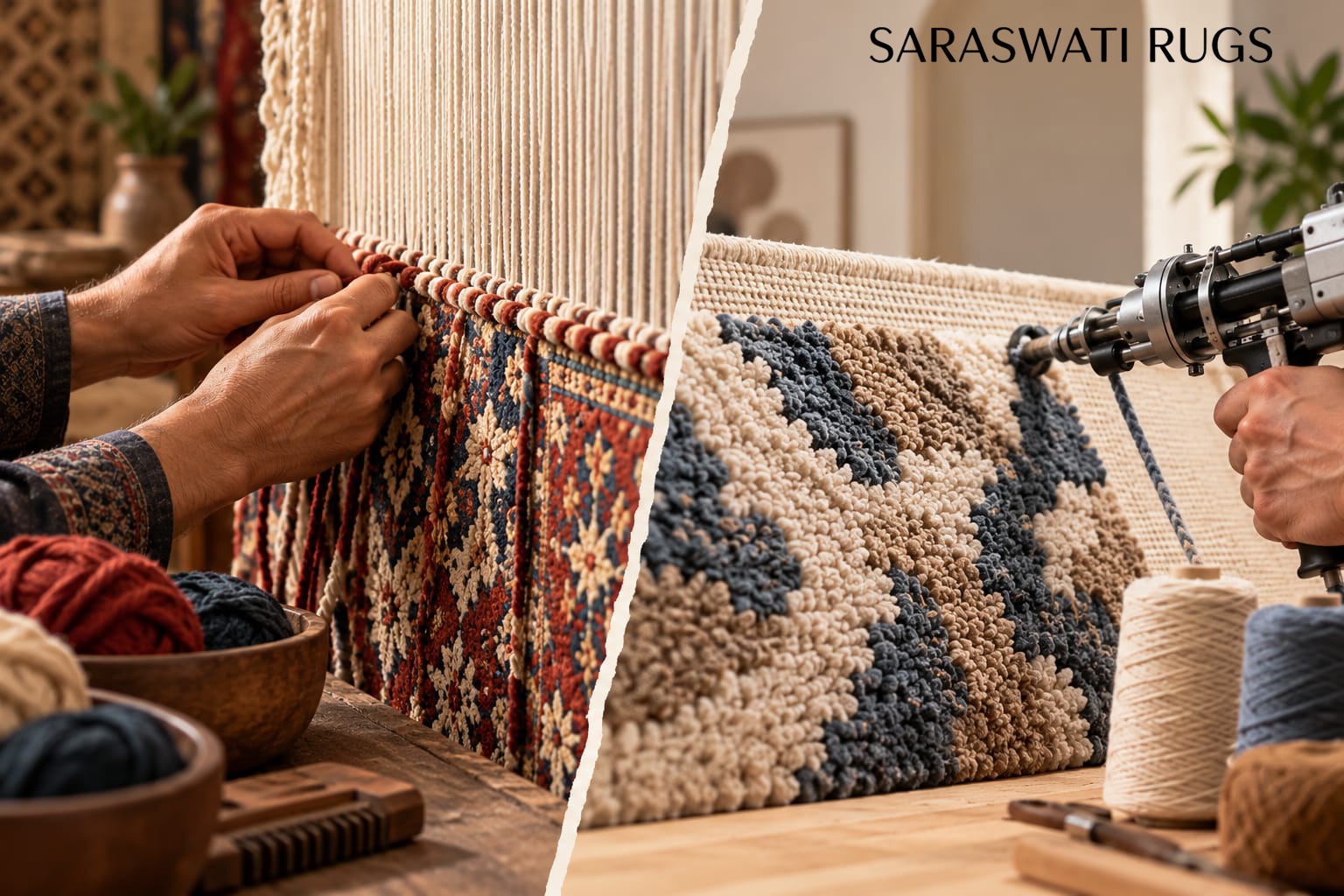
This is the technique that comes up higher on the ladder of craft. On a vertical loom, master weavers tie individual knots — the act of wrapping natural yarn around a vertical warp thread — one at a time. Hand-knotted rug the kind of slow, deliberate work that's been handed down from generation to generation in weaving families.
How Hand-Knotted Rugs Are Made
Setting the loom. Cotton or wool warp threads get stretched vertically across a heavy wooden or metal frame — this becomes the skeleton the whole rug is built on.
Tying every knot by hand. Row by row, the weaver ties each knot using specialized tools, wrapping hand-spun wool or silk around the warp threads and trimming the excess. There's no shortcut here — every single knot is a manual decision.
Weaving and packing the weft. After a row of knots is completed, horizontal threads (the weft) are threaded in all the way across and beaten down tightly with a heavy metal comb, anchoring everything in place.
Washing and shearing. The rug is washed several times by hand once out of the loom to enhance inherent fiber sheen; artisans then shear the surface uniformly to crisp up the pattern.
One square inch can contain from 50 to over 400 knots. Project that across a full-size rug, and that's four to 12 months of artisans on just one piece.
| Feature | Hand-Knotted Rugs | Hand-Tufted Rugs |
| Crafting Process | Tied manually, knot by knot | Fiber punched in with a tufting gun |
| Backing | Integrated fringe and weave | Latex glue plus canvas backing |
| Lifespan | 50–100+ years (heirloom) | 7–15 years |
| Production Time | 4–12 months | 2–4 weeks |
| Price Point | Premium investment | Mid-range, accessible |
What Is a Hand-Tufted Rug?
Hand-tufted rugs give you that cushioned, plush feel with a fraction of the production time. It's still handmade — just with a completely different toolkit.
The Tufting Process
Instead of knotting, a craftsman takes a hand-operated tufting gun to punch loops of yarn through a canvas stretched over a frame in accordance with the traced pattern. When the pattern is complete, we remove the rug from the frame; because all those fibers aren't attached to anything, a heavy latex adhesive layer goes on the back to hold it together. A finishing layer of cotton canvas gets glued over that latex to hide it and give the back a clean look.
Key Structural Differences You Should Actually Know
1. What's Holding It Together
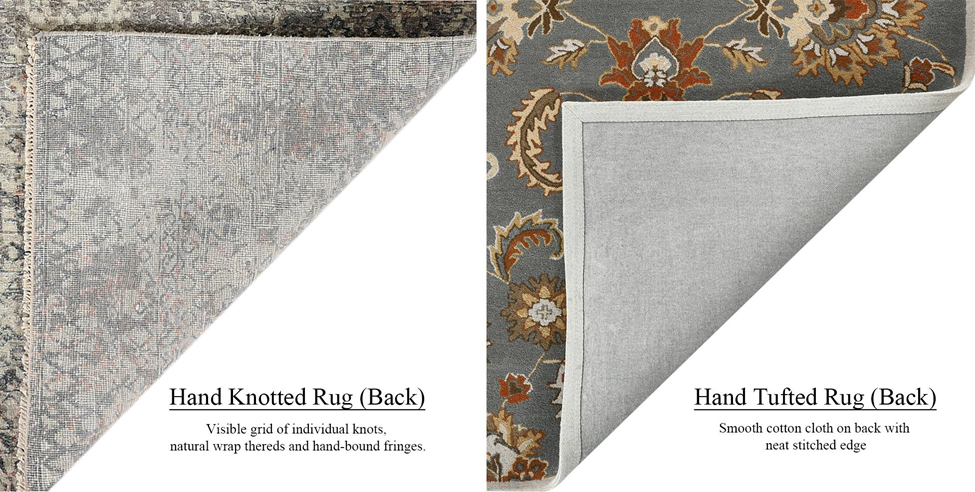
Flip the rug over. That's the fastest way to tell these apart.
A hand-knotted rug shows you the pattern on the back almost exactly as it appears on the front — you can see the individual knot grid, and the fringe is simply a continuation of the warp threads. No glue, no canvas, nothing hidden.
A hand-tufted rug hides all of that behind a flat cotton canvas backing. You won't see any knot structure, because there isn't one — the yarn is held in place internally by latex.
2. How Long It Actually Lasts
Hand-knotted rugs are widely considered some of the most durable handcrafted rugs you can buy, and the reason is simple: there's no synthetic glue in them to break down. They take heavy foot traffic, professional deep cleaning, decades of daily use, and they're the pieces that get handed down as family heirlooms.
Hand-tufted rugs are sturdy enough for everyday life, but their lifespan is tied directly to that latex backing. Somewhere between 7 and 15 years, the latex dries out and starts to crack. When that happens, fibers loosen, and you might even notice fine white dust collecting underneath the rug; that's the adhesive breaking down.
3. How It Feels Underfoot
A hand-knotted rug feels firm, dense, and anchored to the earth—there's an inherent structural crispness to the way knots comprise the pile itself.
Immediately upon emergence, hand-tufted rugs feel soft and full of padding. Due to the tufting process enabling a denser yarn pile over a soft backing, they can feel airier than an equivalent lower-knot-count constructed design.
Comparing Time, Skill, and Cost
Once you see the labor gap, the price gap stops being a mystery.
| Factor | Hand-Knotted | Hand-Tufted |
| Crafting Time | 500–1,500+ labor hours | 20–60 labor hours |
| Skill Required | Master weavers, years of training | Skilled technicians |
| Resale/Heirloom Value | Holds or increases over time | Depreciates as a utility item |
| Cost Range | Luxury investment | Accessible, mid-tier |
For those looking for something with lifelong value, hand-knotted is the category that has been designed for you. Ideal if you change up your interior every few years, hand-tufted is visually striking without the hard-wearing price tag of a permanent addition.
Which Rooms Actually Suit Each One
This comes down to how a room actually gets lived in, day to day.
Hand-knotted rugs work best in:
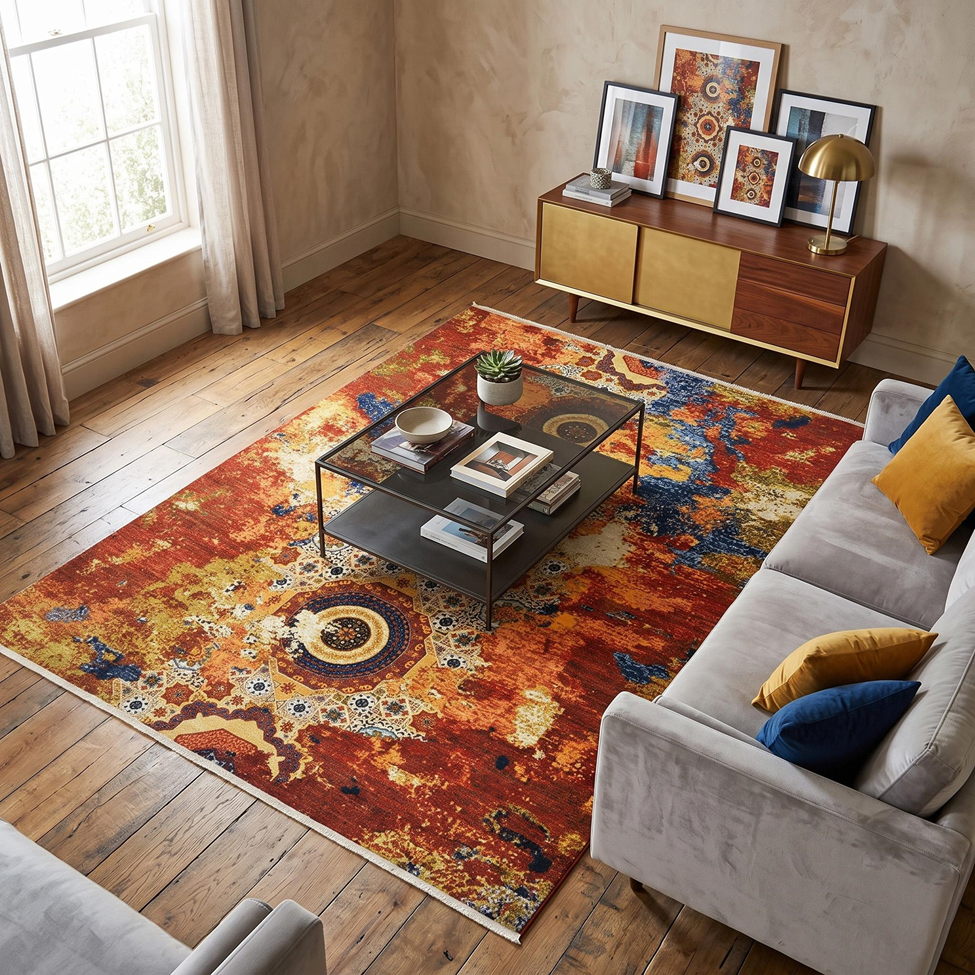
- Living rooms and family hubs — they withstand footfall, moving furniture, and everyday wear without buckling.
- A 9x12 rug is the most popular anchor size for these larger, furniture-heavy spaces, since it's big enough to hold a full seating arrangement without crowding the room.
- Dining rooms — they resist crushing under chair legs and clean up well after spills.
- Entryways and hallways — tracked-in dirt and frequent vacuuming don't wear them down.
Hand-tufted rugs work best in:
- Bedrooms and guest suites — plush comfort underfoot in a lower-traffic space.
- Kids' rooms and playrooms — the soft, cushioned pile gives active kids a forgiving landing spot, and the accessible price point makes it easy to refresh as their taste changes.
- Formal sitting rooms — bold, detailed patterns and deep pile softness for spaces used occasionally.
- Media rooms — thick cushioning that also helps absorb sound.
Caring for Each One
Hand-knotted rugs can handle proper wet washing, spot treatment, and even full immersion cleaning. Because the wool is locked in by the knots themselves, deep dirt lifts out during a wash without weakening the structure underneath.
Hand-tufted rugs need a gentler touch — spot cleaning or professional dry cleaning is the safer route. Soaking one in water may dissolve the latex backing to the point where the canvas comes off altogether from the yarn. Use a vacuum cleaner on a suction-only setting (no beater bar) at regular intervals to keep the pile clean without pulling loose fibres out.
Making the Call
Just before you make a choice, ask yourself four questions;
- What's the budget strategy? Hand-knotted if you're up for a permanent fixture; hand-tufted if you might want to switch things around later on.
- Where will it live? Hand-knotted for high-traffic entryways and dining rooms; hand-tufted for cozy, low-traffic bedrooms.
- Do You Really Want An Heirloom? If this is something that's going to be in the family for 50+ years, handed down, then hand-knotted really is the only way forward.
- What do you care about first wash?
- If soft, deep cushioning matters more than longevity, hand-tufted delivers that at a friendlier price.
Both techniques come from real skill and real hands — they're just built for different jobs. Once you understand what's actually holding each rug together, choosing between them stops being a guessing game.